
Selection Guide
Aluminum Hydroxide Selection Guide for Flame-Retardant Applications
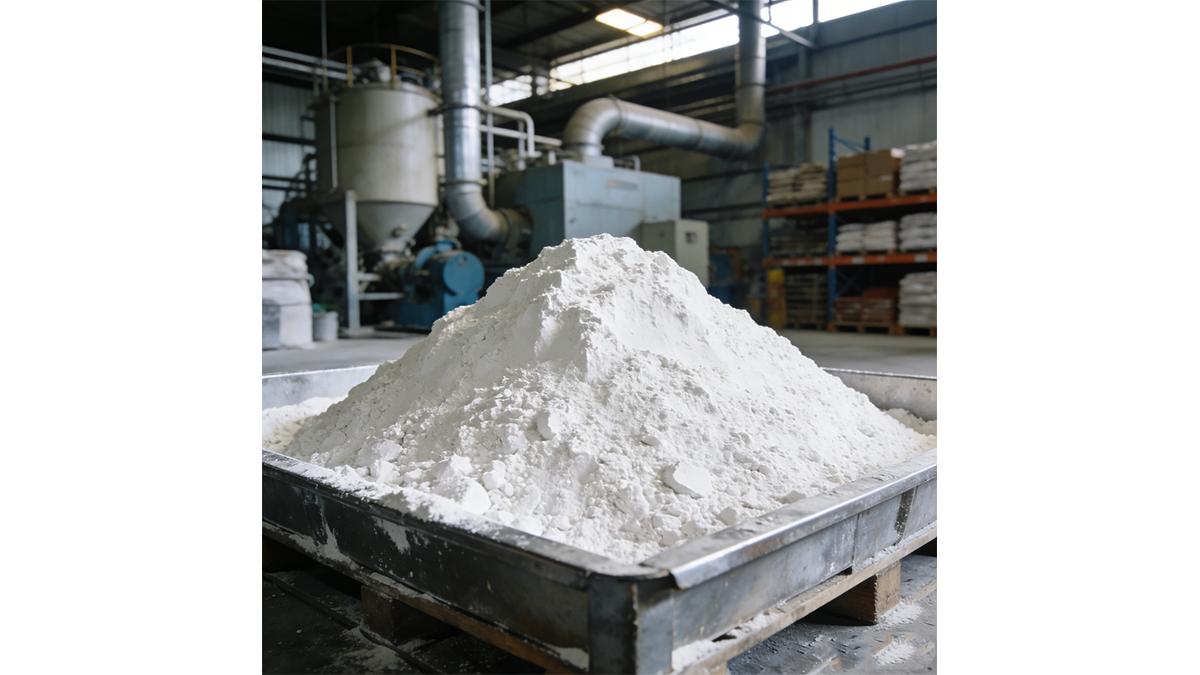
Learn how to select aluminum hydroxide (ATH) for HFFR, wire & cable, electronic insulation and polymer compounds based on particle size, sodium content, oil absorption and processing requirements.
Aluminum hydroxide, also known as aluminum trihydrate or ATH, is a halogen-free inorganic flame-retardant filler widely used in wire and cable compounds, rubber and plastics, electronic insulation materials, thermosetting resins and other highly filled polymer systems.
Selecting the right ATH grade involves more than comparing Al(OH)₃ content. Particle size, sodium content, oil absorption, moisture, whiteness, surface treatment and compatibility with the polymer matrix can all influence processing behavior and finished-product performance.
Origin Chemical supplies multiple aluminum hydroxide grades covering fine to coarse particle-size ranges for different formulation requirements.
Why Is Aluminum Hydroxide Used as a Flame Retardant?
ATH provides flame-retardant functionality through endothermic decomposition.
When exposed to sufficiently high temperature, aluminum hydroxide absorbs heat and releases chemically bound water. This process can help reduce material temperature, dilute combustible gases and contribute to formation of an alumina-rich protective residue.
ATH is therefore widely used in halogen-free flame-retardant systems including:
●HFFR wire and cable compounds;
●EVA compounds;
●PVC cable materials;
●silicone rubber;
●PE and PP compounds;
●polyurethane systems;
●epoxy resins;
●SMC/BMC composites;
●electronic insulation materials;
●flame-retardant coatings and adhesives.
Key Parameters for ATH Selection
Particle Size
Particle size strongly influences filler surface area, dispersion, processing viscosity and surface quality.
A smaller D50 does not automatically mean better performance. The optimum particle size depends on polymer chemistry, filler loading and processing conditions.
Sodium Content
Sodium becomes increasingly important in electronic and electrical applications where ionic impurities need tighter control.
Oil Absorption
Oil absorption can provide an indication of resin demand and processing behavior. This becomes particularly relevant in highly filled polymer systems.
Moisture
Moisture should be considered in resin systems and electrical applications that are sensitive to water.
Origin Chemical QD-F Aluminum Hydroxide Series
Grade Al(OH)₃ ≥ % Na₂O ≤ % D50 μm Oil Absorption ≤ ml/100g Moisture ≤ %
QD-F01 99.6 0.17 0.8–1.3 50 0.15
QD-F02 99.6 0.18 2 40 0.15
QD-F03/05 99.6 0.25 3–6 35 0.25
QD-F08 99.6 0.23 7–9 27 0.25
QD-F10 99.6 0.23 8–11 26 0.25
QD-F14 99.6 0.23 13–18 23 0.25
QD-F20 99.6 0.25 18–25 23 0.20
QD-F25 99.6 0.30 22–28 20 0.20
QD-F50 99.6 0.20 35–45 20 0.20
QD-F75 99.6 0.20 75–90 20 0.10
QD-F90 99.6 0.20 70–100 20 0.10
Please refer to the current Origin Chemical product page and TDS for the latest commercial specification.
Quick Grade Selection
Requirement Grades to Evaluate
Very fine ATH around 1 μm QD-F01
Fine ATH around 2 μm QD-F02
D50 around 3–6 μm QD-F03/05
D50 around 7–11 μm QD-F08 / QD-F10
Medium particle size QD-F14 / QD-F20 / QD-F25
Coarser filler grades QD-F50 / QD-F75 / QD-F90
Lowest listed sodium level QD-F01
Lower oil absorption options QD-F25 / F50 / F75 / F90
These recommendations are intended for initial screening. Final grade selection should be validated in the customer's actual formulation.
ATH for HFFR Wire and Cable
HFFR cable formulations often require high mineral-filler loading.
The selected ATH grade can influence:
●processing viscosity;
●extrusion behavior;
●dispersion;
●mechanical properties;
●surface quality;
●moisture resistance;
●flame-retardant performance.
Fine grades may be evaluated where fine dispersion is important, while larger-particle grades can provide different processing characteristics.
The optimum ATH should always be evaluated together with polymer type, coupling system and filler loading.
ATH for Electronic Insulation
Electronic insulation applications can place greater importance on impurity control, including sodium content.
When selecting ATH for these systems, engineers should consider:
●Na₂O;
●Fe-containing impurities;
●particle size;
●moisture;
●resin compatibility;
●dielectric requirements.
Surface Treatment and Silane Coupling Agents
In highly filled polymer systems, the interface between ATH and the polymer matrix can strongly influence processing and mechanical behavior.
An appropriate silane coupling agent or surface treatment may help improve:
●filler wetting;
●dispersion;
●interfacial adhesion;
●moisture resistance;
●processing behavior.
Origin Chemical also supplies silane coupling agents for inorganic filler modification.
FAQ
What is ATH?
ATH means aluminum trihydrate, Al(OH)₃, commonly referred to as aluminum hydroxide in industrial applications.
Which Origin ATH grade has the smallest particle size?
QD-F01 has a listed D50 range of 0.8–1.3 μm.
Is finer ATH always better?
No. Finer particle size increases surface area and can change viscosity, resin demand and dispersion behavior. The optimum grade depends on the complete formulation.
Can ATH be used in HFFR cable compounds?
Yes. ATH is widely used as an inorganic flame-retardant filler in halogen-free cable formulations.
Need Help Selecting an ATH Grade?
Tell us your polymer system, processing temperature, filler loading, target particle size and performance requirements.